Manufacturing & Workshops

A connected shop.
A promise date you can keep.

Your people know the machines cold. Give them one clear view of the whole shop.

Bring the CNC cells, the press, the weld bay, receiving, inspection and the dock into the same working picture, built around the equipment and expertise you already have. Start with one machine or one handoff, prove it on your floor, and grow what earns its place. Nothing here asks you to replace a control you trust.

Step inside the shop
  • Job shops & CNC
  • Fabrication & welding
  • Tier 2 & 3 auto parts
  • Moulding & tooling
The whole shop, in context

From the receiving door
to the truck that leaves on time.

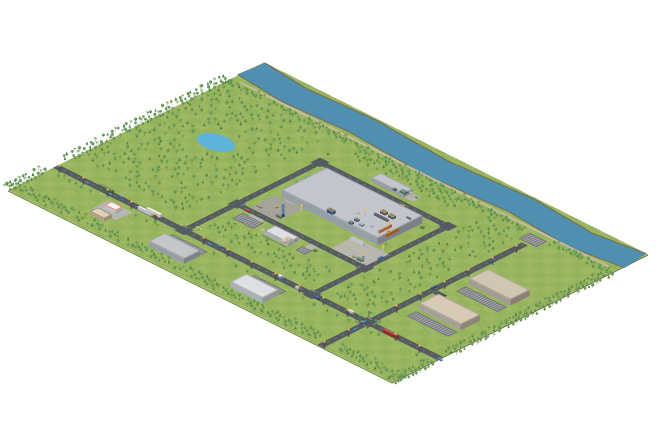
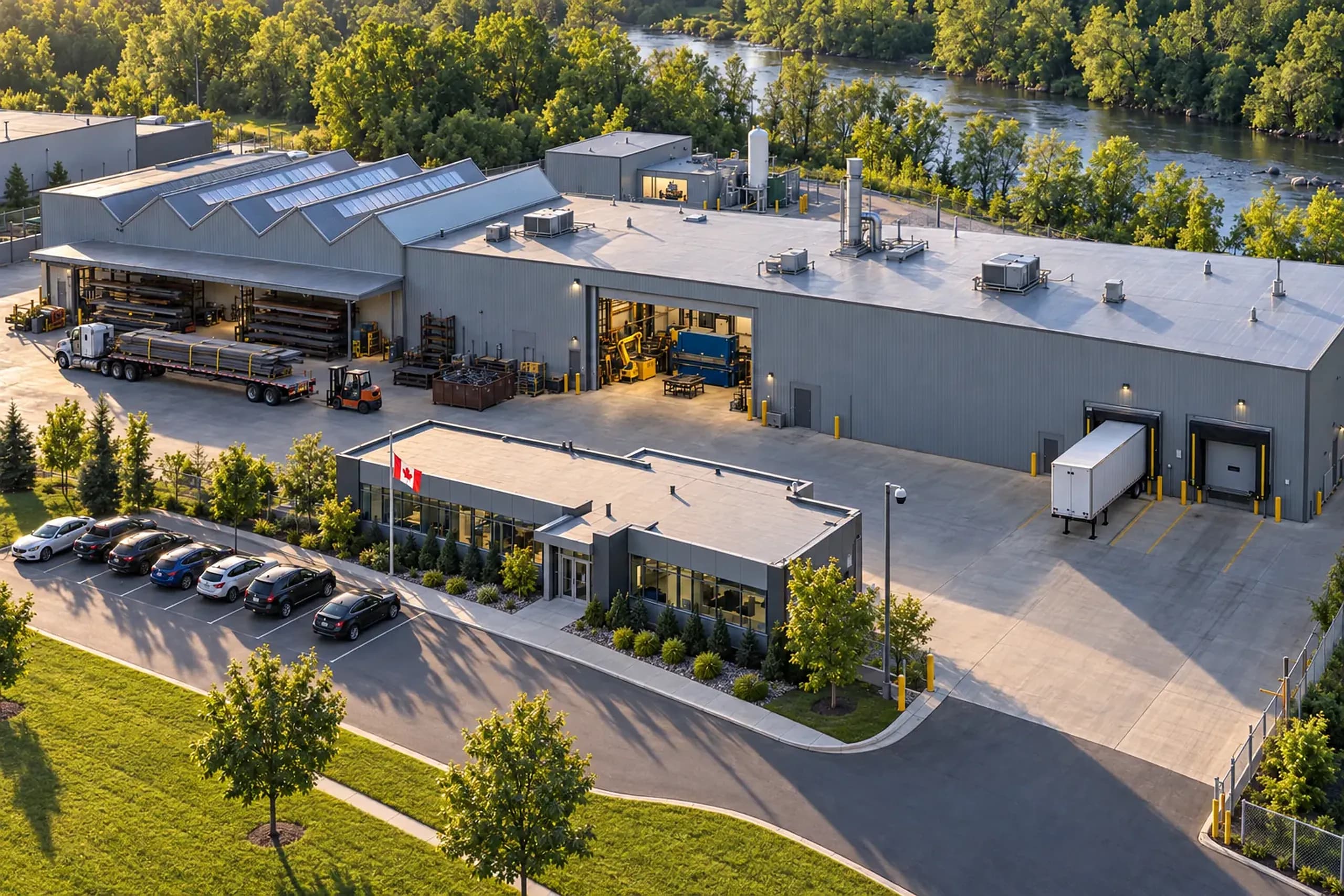
Aerial view of Speed River Fabrication: a sawtooth-roofed plant beside the Speed River in Guelph, steel racks and a flatbed at receiving, two trailers at the shipping dock, the glass-fronted office by the road and the tool-crib annex with its compressor pad

Hover for an idea · click to explore

Watch the resolution, step by step

Here's how we'd handle it.

This walkthrough follows a real scenario built into our interactive demo. It shows the evidence, the decisions and the follow-through — not just an impressive-looking dashboard.

The Thursday the press went quiet01 / 07
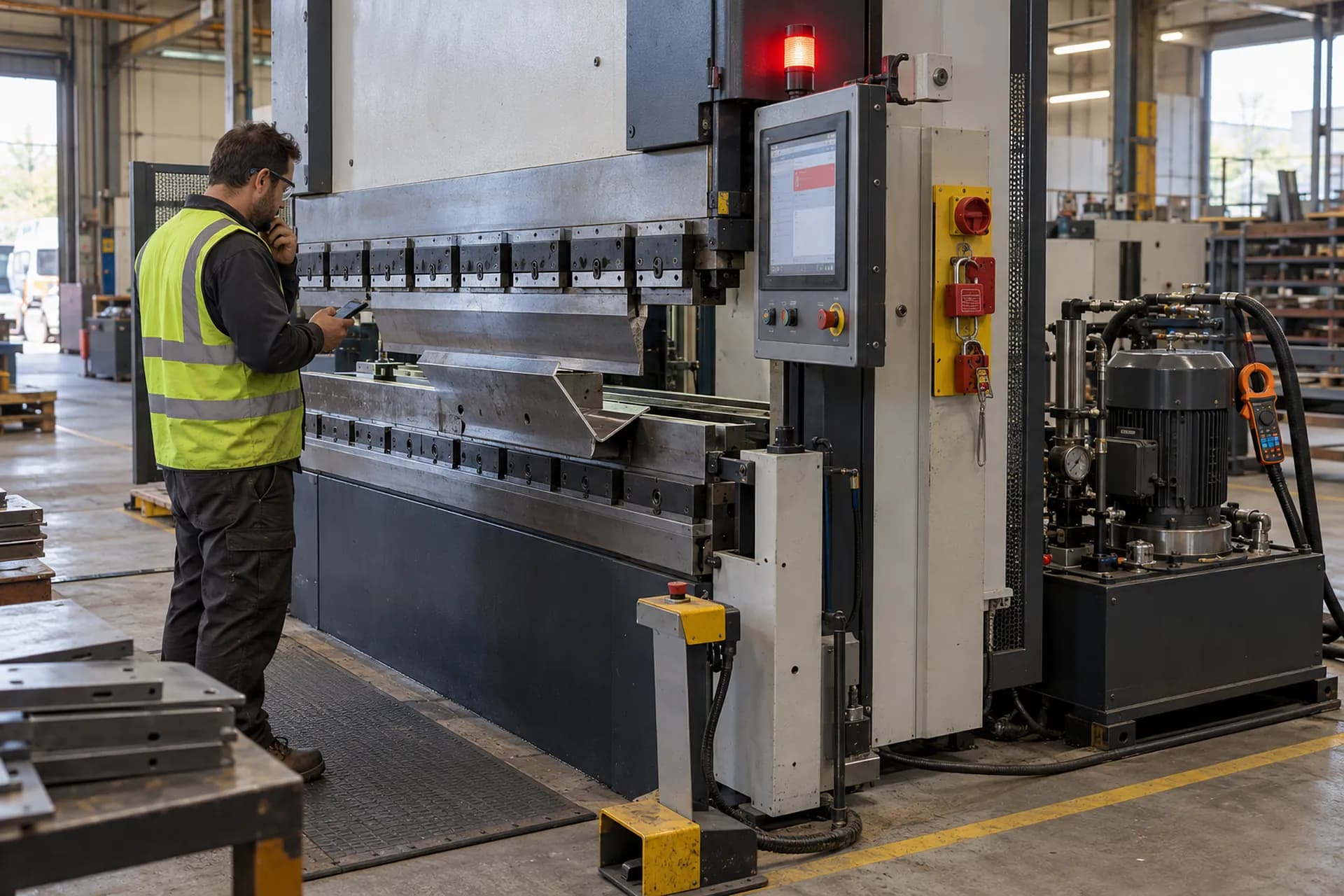
The press brake stopped mid-bend with a red stack light, the hydraulic power unit behind it and a technician reading the fault on the HMI
Guided story · illustrative operation

What happens next

08:34. The fault, not the walk

At 08:34 the press brake's own PLC raises fault 4-07, low hydraulic pressure, and the stack light goes red. The operator knew that second; he lowered the ram onto blocks and locked out. What is new is that the plant manager and maintenance know at 08:34 too, with something the HMI never showed: the current on the HPU motor, read by a clamp and climbing for seven days. Click the press brake alert to open it. A year ago this pump's history was a sticker on the tank.

The underlying problem

The press brake loses hydraulic pressure at 08:34 on a Thursday, and the pump is the likely cause. The millwright who knew it retired in June, the OEM quotes five weeks on a new pump, and two forming jobs promised for next week are stuck behind it. Two-thirds of plants worldwide see unplanned downtime every month; what differs is what the next hour looks like.

The outside millwright arrives knowing what to isolate, the pump is at the Cambridge hydraulic shop the same day and back Monday, and the bracket is off the printer by lunch. The history, the lockout procedure and the spare-pump rule no longer retire with the millwright. One job moved; the other still waited for the pump.

Try this exact scenario in the real demo ↗

Fictional operation and simulated incidents. Human decisions and technical integrations depend on each client's actual systems.

The hold-up isn't always on the machine.

A quiet press.
A stale quote.
A skid still at the plater.

Someone walks the floor to learn what the machines already know. The press brake stops on a Thursday and the fix waits on one phone number. The quote was priced off March's plate, the buyer in Dearborn is asking about landed cost, and Friday's parts are on a skid in Brantford with no status but a phone call.

Connect each moment to the place, the person and the next step. The press brake's own fault reaches maintenance with the pump's history and the rebuild shop's number. The order shows today's plate price and the buyer's landed cost before the call. The skid at the plater becomes a row with a days-out count. Your team spends more of the week making parts and less of it finding out what happened.

The receiving door
The shop floor
The inspection room
The dock
One connected view

Every part of the operation

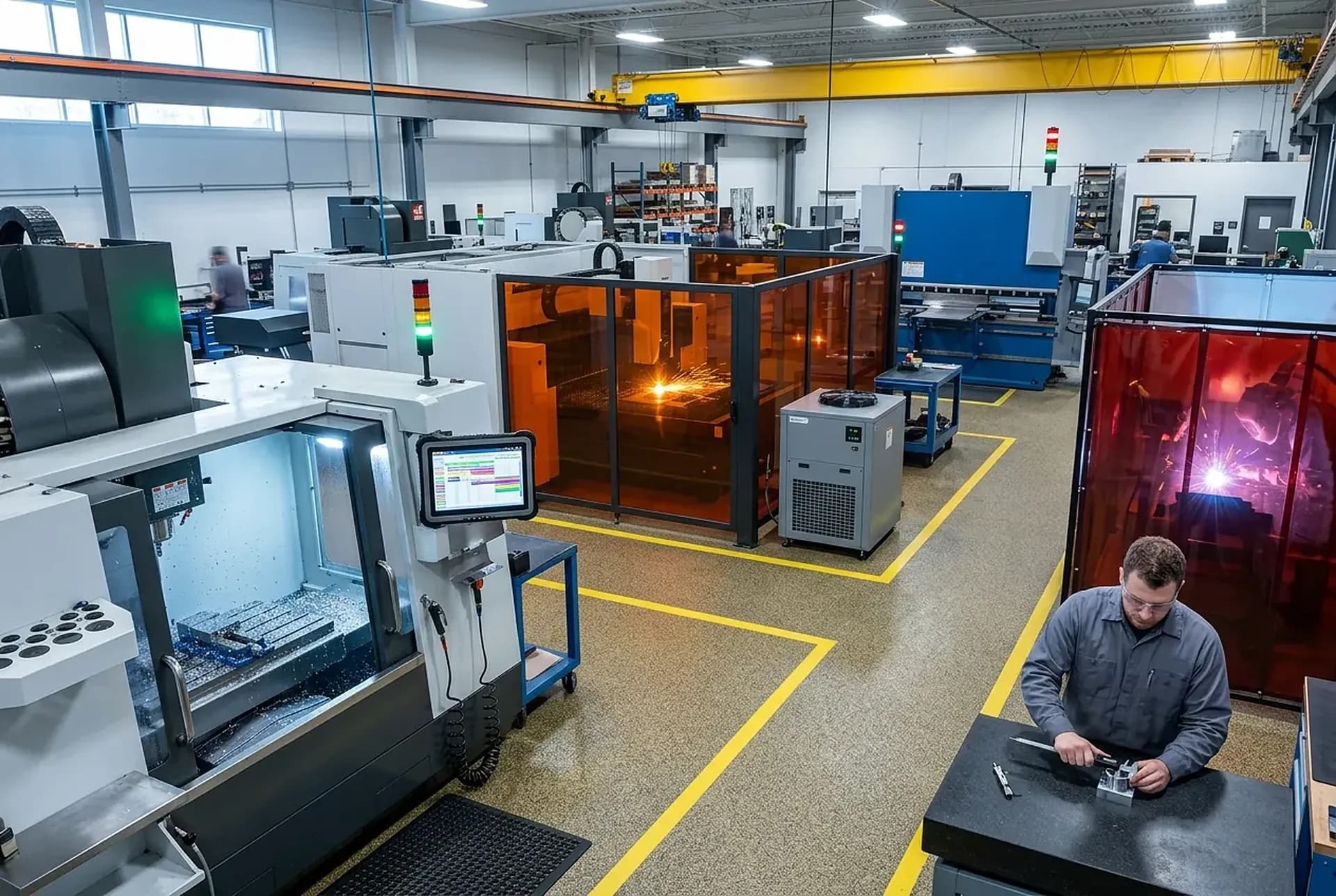
Inside the shop: a Mazak vertical machining centre in cycle, the Haas beside it with its stack light on amber, the fibre laser behind orange glass and the press brake under the crane
Cells & press

The shop floor

Machine state by the minute, quoted hours against real ones, and the stop reasons your operators tag themselves.

Your quotes are built on the hours you think the cells run. A high-mix shop that logs 65 per cent OEE by hand typically shows 50 to 53 once the machines report for themselves. The missing hours hide where nobody writes them down: stops under five minutes, feed overrides at 80 per cent, air-cutting after a program edit, first-off buy-off and 'waiting on program' from the CAM bottleneck. The 2006 Haas has no Ethernet option, so it cannot tell you. Deburr, finishing and paint benches carry a fifth of the hours in most shops and nobody measures them, so the quote promises capacity the floor does not have.

An on-site gateway reads the Mazak over MTConnect and the newer Fanuc over FOCAS; the Haas and the saw get a current clamp or a stack-light tap for a few hundred dollars, enough for state, part count and idle time. Operators tag stops on a shop tablet from a list with no blame on it, which is why they keep tagging. Quoted hours sit beside actual hours per job, finishing bench included. When a machine idles twenty minutes with no reason tagged, the cell lead gets a message, not the owner, and the owner gets one digest at day's end.

On the dashboard
  • Machine state by the minute
  • Spindle-on hours per cell
  • Quoted vs actual hours per job
  • Downtime reasons as tagged
  • Weld arc-on time per operator
  • Finishing-bench hours
Equipment it connects
  • CNC mills and lathes (Fanuc, Haas, Mazak controls)
  • Hydraulic press brake and fibre laser with chiller
  • Robotic weld cell and MIG/TIG welders
  • Paint line with PLC and andon stack lights
  • Current clamps and stack-light taps on older machines
  • Shop tablets for reason tagging
Open this area in the demo
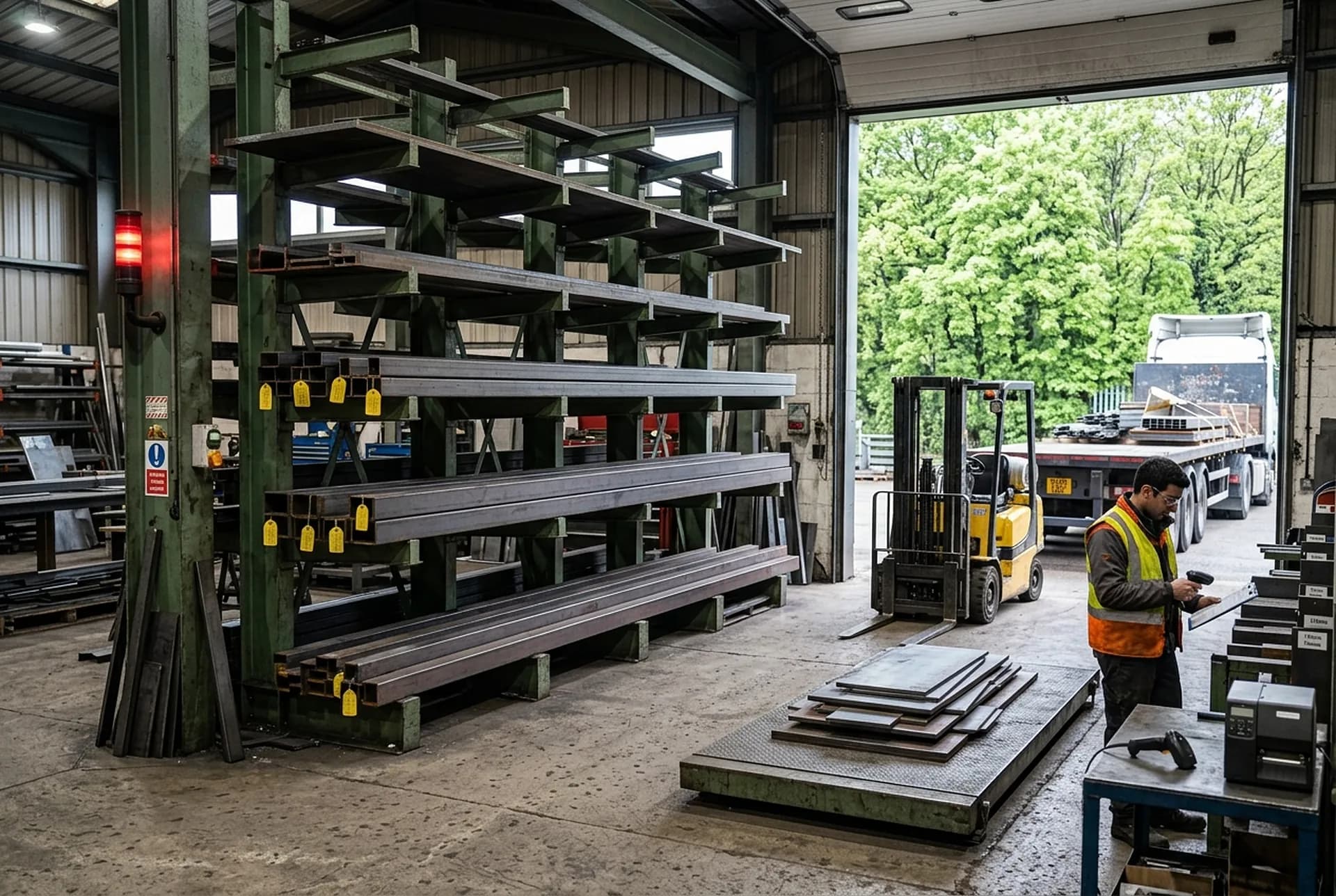
The receiving end: plate and tube on a cantilever rack with heat-number tags, a floor scale, a scanner on the bench and a flatbed outside the door
Receiving

Receiving & raw stock

Heat numbers, PO prices and remnants tied to the job that used them, and the broker's release on a screen.

In an ISO 9001 or structural shop the heat number goes on the traveller and the mill test report is filed for the auditor. What never reaches the job is what the plate cost, how the nest yielded on the laser and the drop left on the remnant rack, which is where a fab shop's material margin hides. Plate moves with the mills' price letters, $100 a short ton, about $110 a tonne, in November 2025 alone, while a quote keeps the price of the day it was written. Since September 8, 2026, Canada's 50 per cent surtax on US steel and aluminum reaches the shop's own imports, and the broker's release lives in an email.

The receiving scan ties the heat or lot, the PO price and the certificate to the job that consumes it, and the nesting software reports yield and drops by grade and thickness. Today's price list sits against the price assumed in every open quote; when the gap passes what the surcharge clause allows, purchasing and the estimator are told before the next quote goes out. The broker's release email is parsed onto the board, and duty, surtax and the day's USD/CAD rate land in the job cost in Canadian dollars. The receiver sees the heat number, the rack and the job on one screen.

On the dashboard
  • Heat and lot linked to job
  • PO price vs quoted material
  • Nesting yield and remnants
  • Days of stock by grade
  • Broker release status
  • Landed duty and surtax per PO
Equipment it connects
  • Barcode scanner and label printer at the dock
  • Floor scale and plate, bar and remnant racks
  • Mill test reports and certificates of analysis
  • ERP purchasing module
  • CARM Client Portal and customs broker
  • Laser nesting software
Open this area in the demo
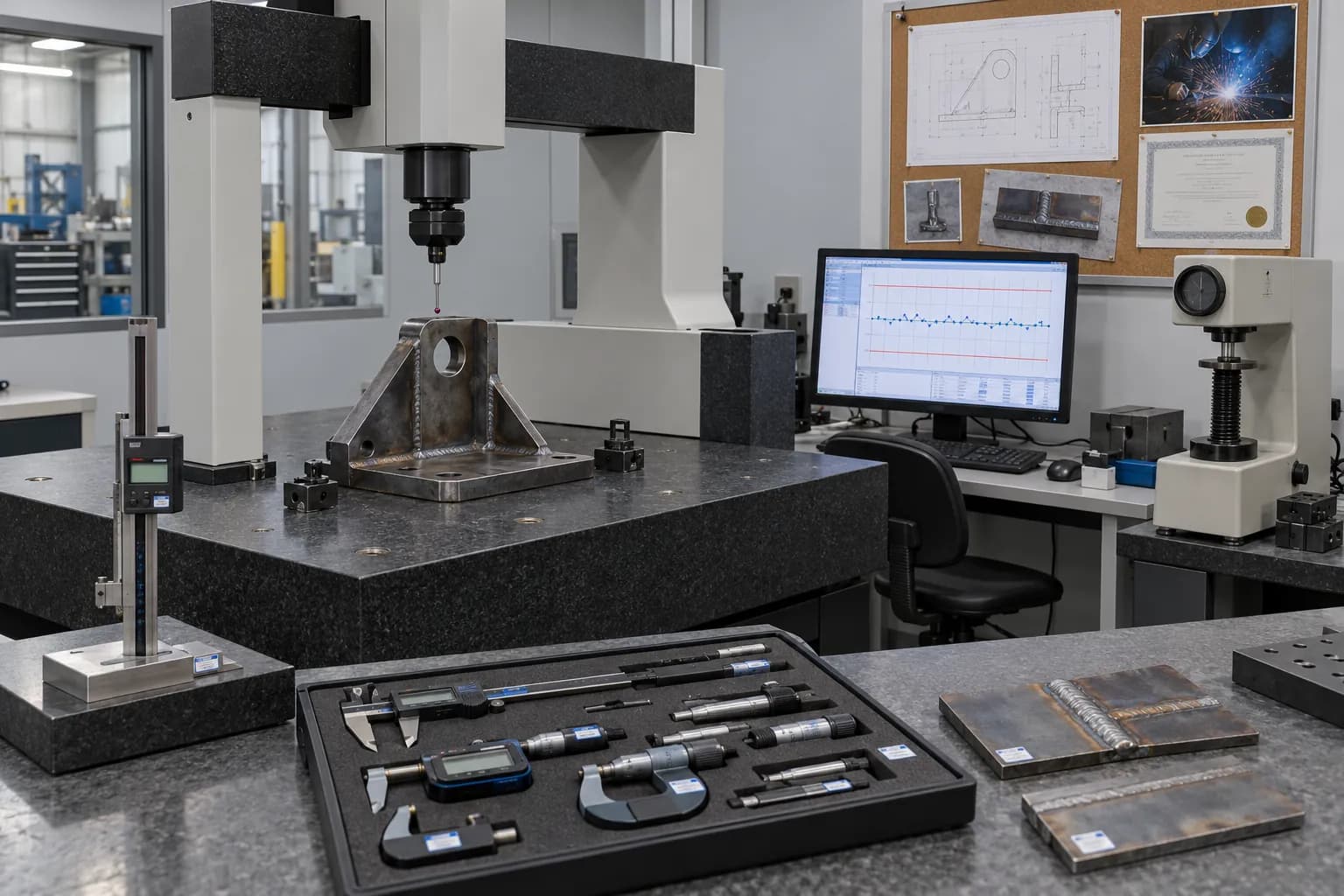
The inspection room: a CMM measuring a welded bracket, Bluetooth calipers in a foam tray, a hardness tester and a calibration sticker on every gauge
Inspection

Quality & inspection

First-pass yield by job and machine, the 8D that starts with data, and the tickets and gauges that expire.

Measurements get written on travellers, NCRs live in email and the Cpk on a critical dimension is worked out at month end, if at all. One moulding program quoted at 3 per cent scrap was running 9.2 per cent eighteen months in, and with measurements on paper nobody can say which machine or shift the scrap comes from. On the CNC floor the recurring losses are first-part scrap and loading the wrong program revision. The customer's 8D request or scorecard hit lands before the shop knows what happened. In a weld shop the paper that bites is a CWB ticket lapsing before a job, or no WPDS covering a new joint.

Bluetooth calipers, micrometers and the CMM report attach each measurement to the job, the machine and the operator at the bench, so first-pass yield and scrap dollars by cause appear the same day. A drifting Cpk raises an alert to the quality lead instead of a month-end discovery. An 8D from the customer portal opens with the traveller and the cell already attached. Welder tickets, the WPDS register and gauge calibration dates raise a note thirty days out. When the auditor or the customer asks, the record pack is a filter on a date range, not a hunt through a binder.

On the dashboard
  • First-pass yield by job and machine
  • Scrap and rework dollars by cause
  • Cpk on critical features
  • Open NCRs and 8Ds by age
  • Welder ticket and WPDS coverage
  • Gauge calibration due
Equipment it connects
  • CMM and surface plate
  • Bluetooth calipers and micrometers
  • Hardness tester and weld gauges
  • Gauge calibration register
  • NCR / CAPA / 8D tracking
  • Customer scorecard portals
Open this area in the demo
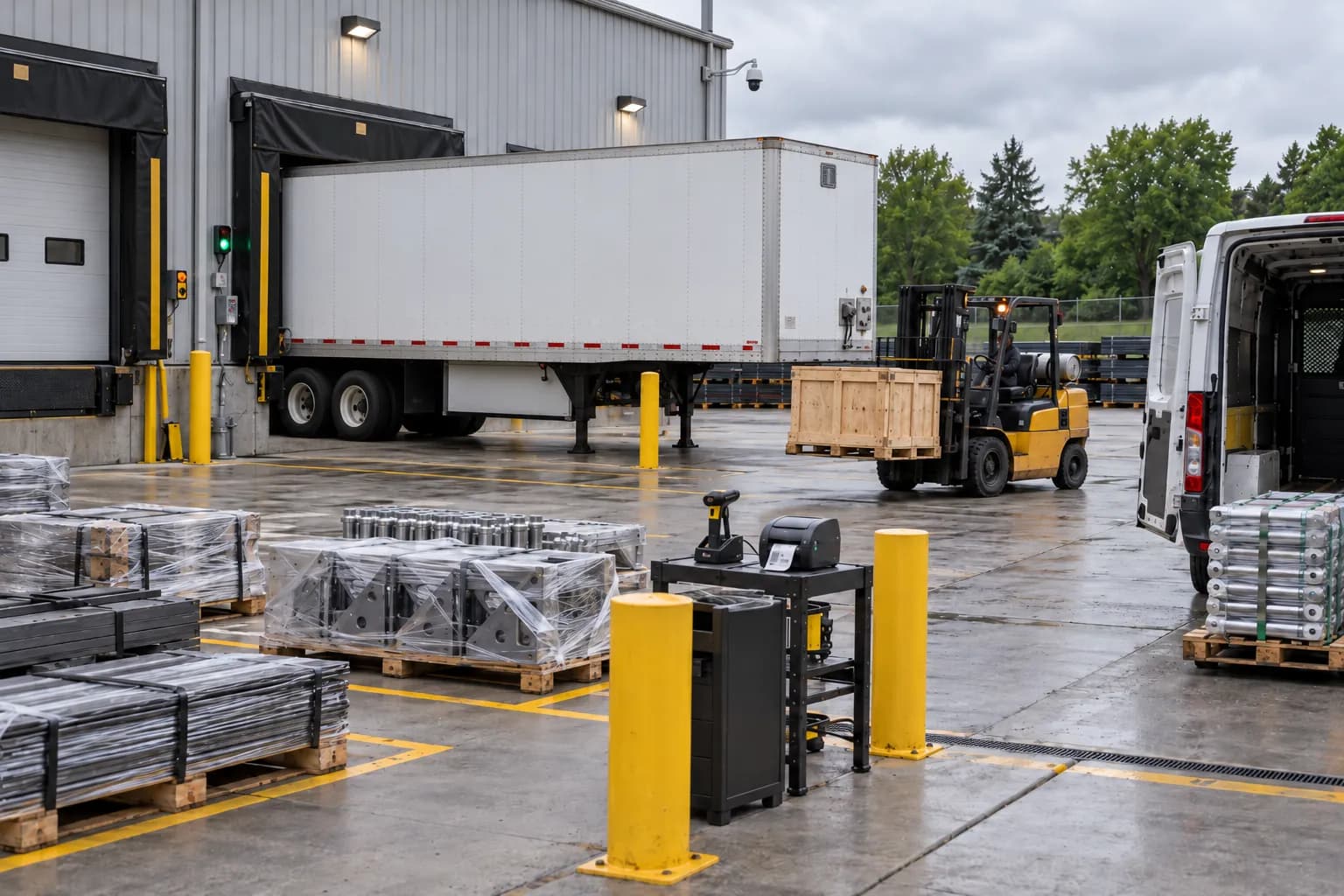
The shipping dock: wrapped pallets staged in painted lanes, a scan-verify station with a label printer, a trailer at dock 2 and a skid back from the plater
The dock

Packing & shipping

Orders by promise date, labels verified before the truck, and the parts still at the plater on a screen.

Every wrong label or revision is a chargeback, a scorecard hit and an 8D; warehouse benchmarks put misshipments at 2 to 3 per cent of orders, and a Tier 2 shop under 1 per cent wrong still pays for each one. Plating and heat treat happen at other shops in Cambridge, Guelph or Brantford, and the skid that left last week has no status but a phone call. For US-bound steel parts the HS code, the metal content and the melt-and-pour country now decide what the importer pays. The dock board is a whiteboard, and 'where is my order' is a call to the shipper.

A scan-verify station checks every carton label against the release and part master before the wrap goes on, and holds the ASN until it passes. Outside operations sit in the router with the vendor's PO, days out against quoted turnaround and the cert due back with the skid. Door sensors and carrier ETAs show which dock is live. Each US line carries HS code, metal content, melt-and-pour and origin marking as a checklist. A client-service agent answers routine status questions on email and the portal, after hours, and hands exceptions to a person. The shipper hears about a failed scan before the truck does.

On the dashboard
  • On time in full
  • Scan-verify pass rate
  • Jobs at outside vendors · days out
  • Documentation complete per US line
  • Pallets staged and days waiting
  • Status enquiries answered by the agent
Equipment it connects
  • Scan-verify station and AIAG label printer
  • Pallet wrapper, strapping and floor scale
  • Dock-door sensors and yard camera
  • Carrier portals and EDI 862 / 856
  • Customs documents: HS, metal content, melt-and-pour
  • Returnable racks and dunnage
Open this area in the demo
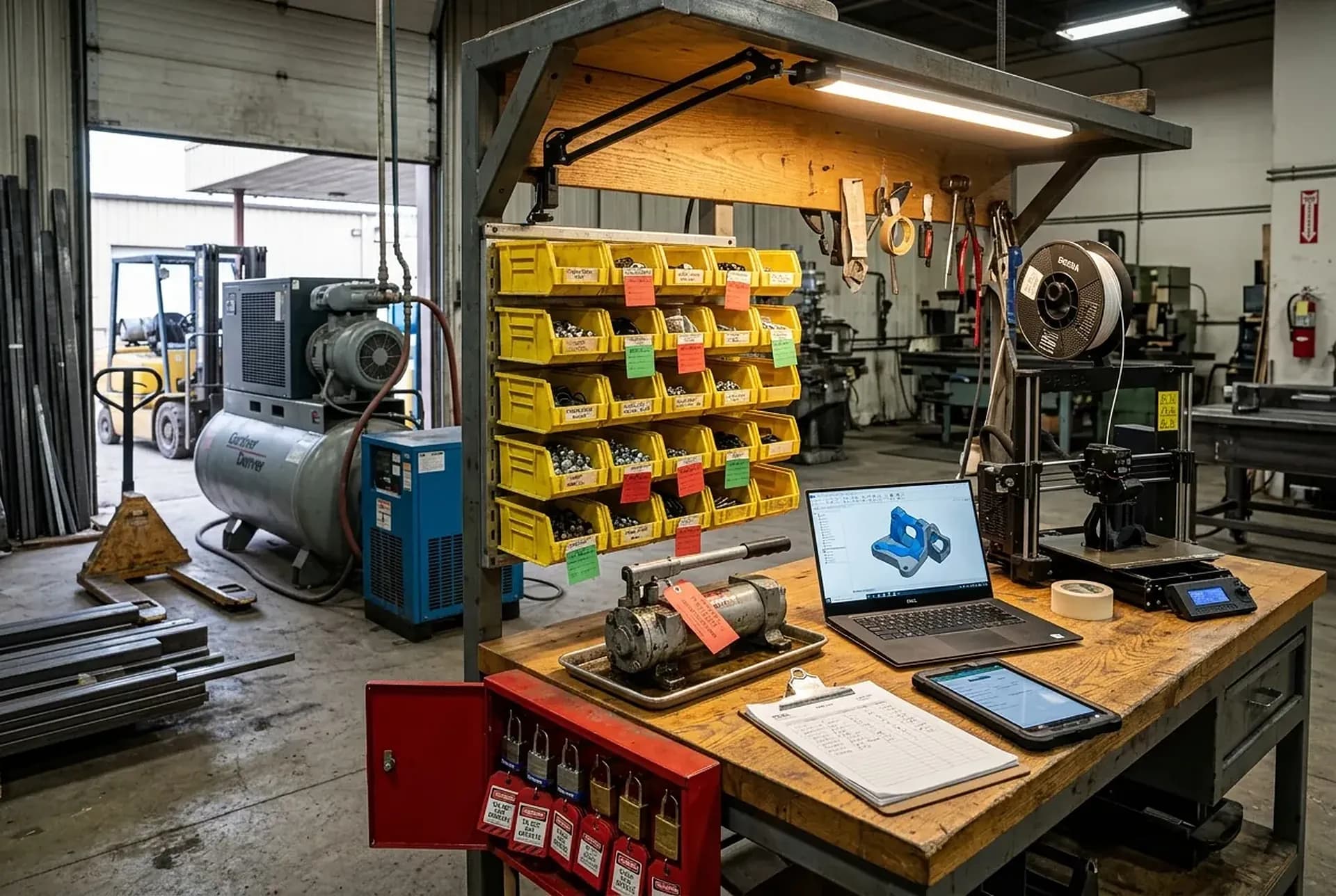
The tool crib and maintenance bench: a desktop 3D printer printing a sensor bracket, spare-parts bins with min/max tags, a lockout station and the compressor through the door
The crib

Maintenance & tooling

Fault codes that open work orders, a critical-spare rule, and the parts that print overnight.

The millwright who knows the press line is the single point of failure: PMs are what he remembers, spare min/max is in his head, and the compressor's history is a sticker on the tank. CME's 2025 survey found 44 per cent of Ontario manufacturers expecting millwright shortages, with about 22,500 retirements a year through 2033. Two-thirds of plants worldwide see unplanned downtime every month, maintenance still runs on clipboards and parallel spreadsheets, and the only windows for big work are the July shutdown and Christmas. A discontinued SLC 500 holds a line hostage, and a quarter of the compressor's output leaks away unheard.

PLC fault codes, andon state and the current clamps on the HPU and compressor motors reach the dashboard through the floor gateway. A fault or a current threshold opens the work order with the asset's history, the crib stock, the local rebuild vendor's number and the lockout procedure attached, and the outside millwright gets it by text. Brackets, guards and pendant housings flagged printable go straight to the FDM queue with a time estimate. A critical-spare rule per asset keeps the one pump the shop cannot run without on the shelf. The compressor's duty cycle on the dead shift is costed at your own blended rate, not the ten cents a kilowatt-hour in NRCan's leak tables.

On the dashboard
  • PLC fault codes and andon state
  • HPU and compressor motor current
  • Open work orders by age
  • Crib stock vs lead time
  • Print queue and printable spares
  • Compressor load on the dead shift
Equipment it connects
  • CMMS work orders and PM checklists
  • Current clamps and vibration sensors
  • Spare-parts crib with min/max
  • FDM 3D printer and part scanner
  • Compressor, dryer and ultrasonic leak detector
  • Lockout stations (CSA Z460)
Open this area in the demo
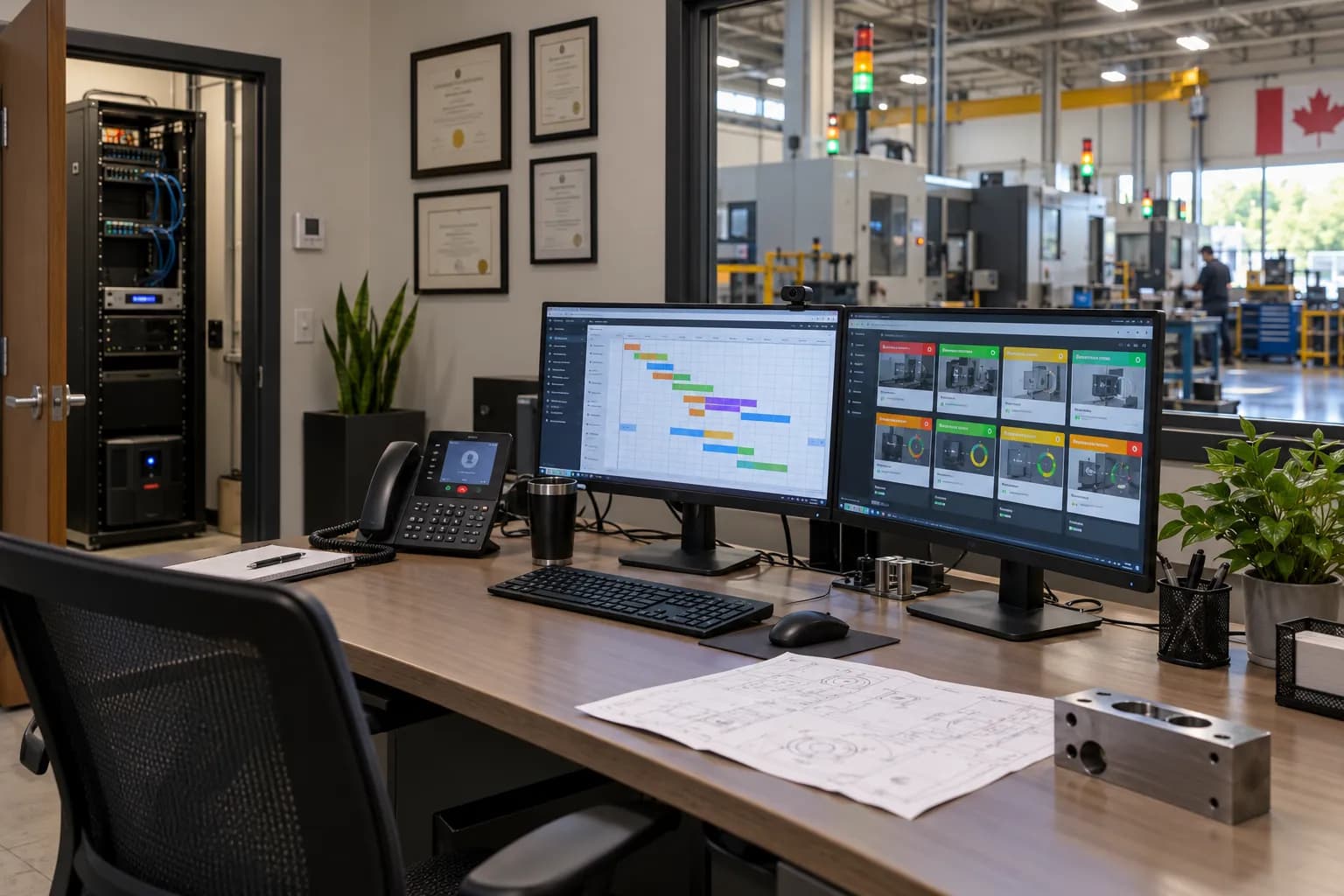
The front office: two screens with the schedule and the quote log, a drawing on the desk, the window onto the shop floor and the network rack through an open door
The office

The office

Quotes that match the floor, US orders priced on today's numbers, and a network the insurer will sign off on.

Everything lands on the office desk at once. Quotes live in your head and in spreadsheets; a job shop wins about a third of them, and buyers want an answer inside 24 hours. A quote with no expiry sits open while plate and the dollar move, and since April 2026 the US duty on a derivative part is charged on the full invoice. Behind the desk the network is flat, a vendor's remote login never closes and the backup is a USB stick in a drawer. Even the hydro bill hides one: the month's billed demand, set by a 4 p.m. start nobody saw.

An AI client-service agent logs each RFQ, pulls part numbers, quantities and due dates into the quote log, acknowledges the buyer and nags when a quote is 24 hours old; the estimator still quotes, from a template updated with actual hours. Every US quote carries today's material price, the FX assumption and the buyer's duty layer, with a margin floor beside it. A firewall splits the controls from the office PCs, vendor access is approved per session and logged, and immutable backups are restore-tested with the owner's laptop included. One security card answers the broker's questionnaire, and a demand alert names the loads to stagger at 4 p.m. before they set the month's peak.

On the dashboard
  • RFQ-to-quote hours and win rate
  • Quotes past 30-day validity
  • US orders with stale assumptions
  • Billed demand vs month peak
  • Backup last-success and restore test
  • Open vendor remote sessions
Equipment it connects
  • ERP / shop management and quoting sheets
  • CAD/CAM workstations
  • Firewall with IT/OT VLANs and managed Wi-Fi
  • Vendor remote-access gateway
  • Immutable off-site backups and UPS
  • LDC interval data (Green Button)
Open this area in the demo
Guided scenarios

Pick a real problem.
Watch it get solved.

Each scenario opens the live demo and walks you through it click by click: the exact control to press, what the dashboard is doing behind it, and what that means for your day. Press Start on any card to begin.

  1. Scenario 01 · Today
    4 min

    The Thursday the press went quiet

    The press brake loses hydraulic pressure at 08:34 on a Thursday, and the pump is the likely cause. The millwright who knew it retired in June, the OEM quotes five weeks on a new pump, and two forming jobs promised for next week are stuck behind it. Two-thirds of plants worldwide see unplanned downtime every month; what differs is what the next hour looks like.

    The outside millwright arrives knowing what to isolate, the pump is at the Cambridge hydraulic shop the same day and back Monday, and the bracket is off the printer by lunch. The history, the lockout procedure and the spare-pump rule no longer retire with the millwright. One job moved; the other still waited for the pump.

    • Maintenance & tooling
    • The shop floor
    • The office
    Start this scenario
  2. Scenario 02 · Today
    4 min

    The call from Dearborn about landed cost

    In March you quoted a Dearborn customer forty welded brackets a release, EXW, and the blanket order came in April, inside the quote's 30 days. Since the April 2026 proclamation the US duty applies to the full invoice value, and the buyer calls at 09:30 to ask for a price cut or threaten to resource to Ohio. Plate has moved too, and nobody has read the surcharge clause since spring.

    You take the 09:30 call with the margin floor, the buyer's real landed cost and the documentation already in hand, and the surtax on the inbound tooling is in the job cost before the invoice lands. The duty itself does not go away.

    • The office
    • Receiving & raw stock
    • Packing & shipping
    Start this scenario
  3. Scenario 03 · Today
    4 min

    The wrong label at dock 2

    A carton at dock 2 carries revision C on the label while the EDI release calls for revision D, the chargeback and the 8D from last week's identical mistake arrived together, and the pins for Friday are on day six of a four-day turnaround at the zinc plater in Brantford, with no status but a phone call.

    The mislabel is caught before the truck instead of after, the 8D starts with the data instead of a search for it, and the skid at the plater is a row with a days-out count instead of a phone call. A shop already under 1 per cent wrong counts the win in chargebacks avoided.

    • Packing & shipping
    • Quality & inspection
    Start this scenario
  4. Scenario 04 · 2027
    4 min

    The vendor who never logged out

    The broker's cyber-insurance questionnaire for the 2027 renewal and a Tier 1's security addendum land the same week. The laser maker's remote-service session has been open to the fibre laser since April, two discontinued SLC 500s run the paint line, and the only copy of the quote spreadsheet is on your laptop. Ransomware incidents in Canada rose an average of 26 per cent a year from 2021 to 2024.

    You answer the insurer and the Tier 1 with evidence from one screen and close one of the easiest ways in. It lowers exposure and recovery time; it does not promise a breach cannot happen.

    • The office
    • Maintenance & tooling
    • The shop floor
    Start this scenario
Live demo

Step inside
Speed River Fabrication

Walk every area, watch the alerts arrive, open the details behind them and run the guided scenarios yourself. It is a fictional operation built for the demo: nothing to install, no account, nothing of yours is collected.

Guelph, Ontario · 4,500 m² plant · 3 CNC cells · press brake · weld bay · paint line · 2 dock doors

Try the live demo4 guided scenarios · 6 areas
Speed River Fabrication · Overview · 08:41
Today and 2027

What the next two years
ask of the shop.

The pressures on a Guelph or Cambridge shop come with dates and sources. Each one below is a rule, a price or a head count already on the calendar, whether or not a single machine is connected.

Today

01
Duty on the full invoice, not the metal
Since the April 2, 2026 proclamation, US Section 232 duties on derivative steel and aluminum products are assessed on the full customs value in tiers from 10 to 50 per cent; parts under 15 per cent subject metal are exempt, and a CUSMA certificate does not relieve this layer. The importer pays, so a Cambridge shop on EXW terms feels it as a Michigan buyer demanding a price cut.
02
The millwright is the single point of failure
CME's May 2025 Ontario report found 44 per cent of manufacturers expecting shortages of industrial mechanics and millwrights and 40 per cent expecting the same for machinists, CNC operators and tooling inspectors; one in four factory workers was 55 or older, with about 22,500 retirements a year through 2033. Setups, PM routines and machine quirks live in one head, and nothing is written down.
03
The floor runs less than the quote assumes
Typical OEE for a high-mix CNC job shop is 40 to 60 per cent, and a shop reporting 65 on manual tracking usually shows 50 to 53 once monitored, because stops under five minutes, feed overrides and air-cutting never make a handwritten log. Only 12 per cent of Canadian manufacturers track OEE at all. Owners want spindle hours and quoted-versus-actual, not a lecture.
04
Ransomware is a manufacturing problem now
The Cyber Centre reports a 26 per cent average yearly rise in Canadian ransomware incidents from 2021 to 2024 and names Akira among the strains hitting Canadian manufacturers; the average ransom paid in 2023 was $1.13 million. Only 26 per cent of businesses have a written cyber policy and 22 per cent carry cyber insurance, while the vendor's remote login stays on and the backups sit on a USB stick.

2027

01
January 1, 2027, and the yearly CUSMA review
A 50 per cent US tariff on autos, parts and steel is announced for January 1, 2027, not yet in effect; CUSMA was not renewed at the July 2026 review and stays in force, reviewed yearly. At home, the Buy Ontario directive has restricted US businesses from provincial procurement since April 13, 2026, and a shop that can show origin paperwork and Canadian steel content is ready for the 2027 bid cycle.
02
ISO 9001:2026 and the customer's transition question
ISO 9001:2026 was published in September 2026 with a three-year transition; certificates to the 2015 edition cease to be valid after September 30, 2029, and the first new certificates are expected around 2027. That is when OEM and Tier 1 customers start asking suppliers for a transition plan and for records and traceability that can be audited, which a binder of travellers cannot offer.
03
Bill C-8 and the security addendum
Bill C-8 received Royal Assent on June 15, 2026 and brings 72-hour incident reporting and supply-chain security duties to designated operators in utilities, rail and telecom. That it will flow down to the shops that supply them is our inference, not government policy, but the Tier 1 addendum already asks for MFA coverage, vendor-session logs and restore-test dates, which a yes/no form cannot show.
04
The grant question, with dates
The Ontario Made Manufacturing Investment Tax Credit refunds 15 per cent on Class 53 machinery for CCPCs, on spending from May 15, 2025 through 2029, up to $3 million a year. Budget 2025 raised the SR&ED enhanced-credit limit to $6 million and made capital spending eligible again, and the proposed Productivity Mega Deduction is still draft legislation. Save on Energy's Retrofit Program pays up to half of eligible costs. Check each with your accountant before counting on it.
A practical partner. A useful first step.

Let your shop's know-how
travel further.

You know the machines, the customers and the quirks. We connect the controls, the readings and the people around them, starting with one cell, and we say so if we are not the right people.

  1. 01
    Walk the shop
    We spend a day on your floor: the controls that already speak, the ones that need a clamp, the whiteboard, the crib, the phone numbers the shop depends on. We leave with the one hold-up worth fixing first.
  2. 02
    Prove one connection
    One cell, one press or one handoff, on your existing equipment and with your people. The cell lead gets the alerts, you get the digest, and we measure what changed in a month.
  3. 03
    Build on the result
    Add the next machine, the receiving scan or the dock once the first one has earned its place. Nothing is replaced for the sake of it, and we say so when something isn't worth connecting.
Start with a real shop problem.

What should be
easier tomorrow?

A press that stops and a fix that waits on one phone. A quote priced off March's plate. A skid at the plater nobody can see. Start with the part of the week you would most like to change.

Pick everything that applies

Takes you to the contact form with these notes filled in. A real person replies within one business day.