

Hospitality & Property Management

A connected property.
Hear it before the guest does.

Your people know how to run a good house. Give them one clear view of the rooms, the readings and the arrivals.

Bring the front desk, the housekeeping board, the hot tub controller, the boiler room, the lot and the rent roll into one working picture, built around the property system, the locks and the people you already have. Start with one room, one reading or one handoff, and grow only what earns its place.

Step inside the property
  • Hotels & resorts
  • Inns & lodges
  • Motels
  • Property managers
  • Multi-unit landlords
  • Caribbean resorts
The whole property, in context

From the front desk
to the far end of the lot.

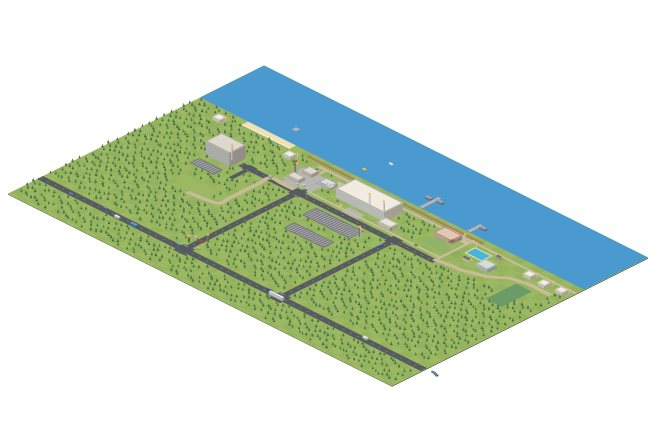
Aerial view of a lakeside Muskoka inn with a pool, spa, restaurant, parking and a residence building

Hover for an idea · click to explore

Watch the resolution, step by step

Here's how we'd handle it.

This walkthrough follows a real scenario built into our interactive demo. It shows the evidence, the decisions and the follow-through — not just an impressive-looking dashboard.

The 8:15 gap01 / 08
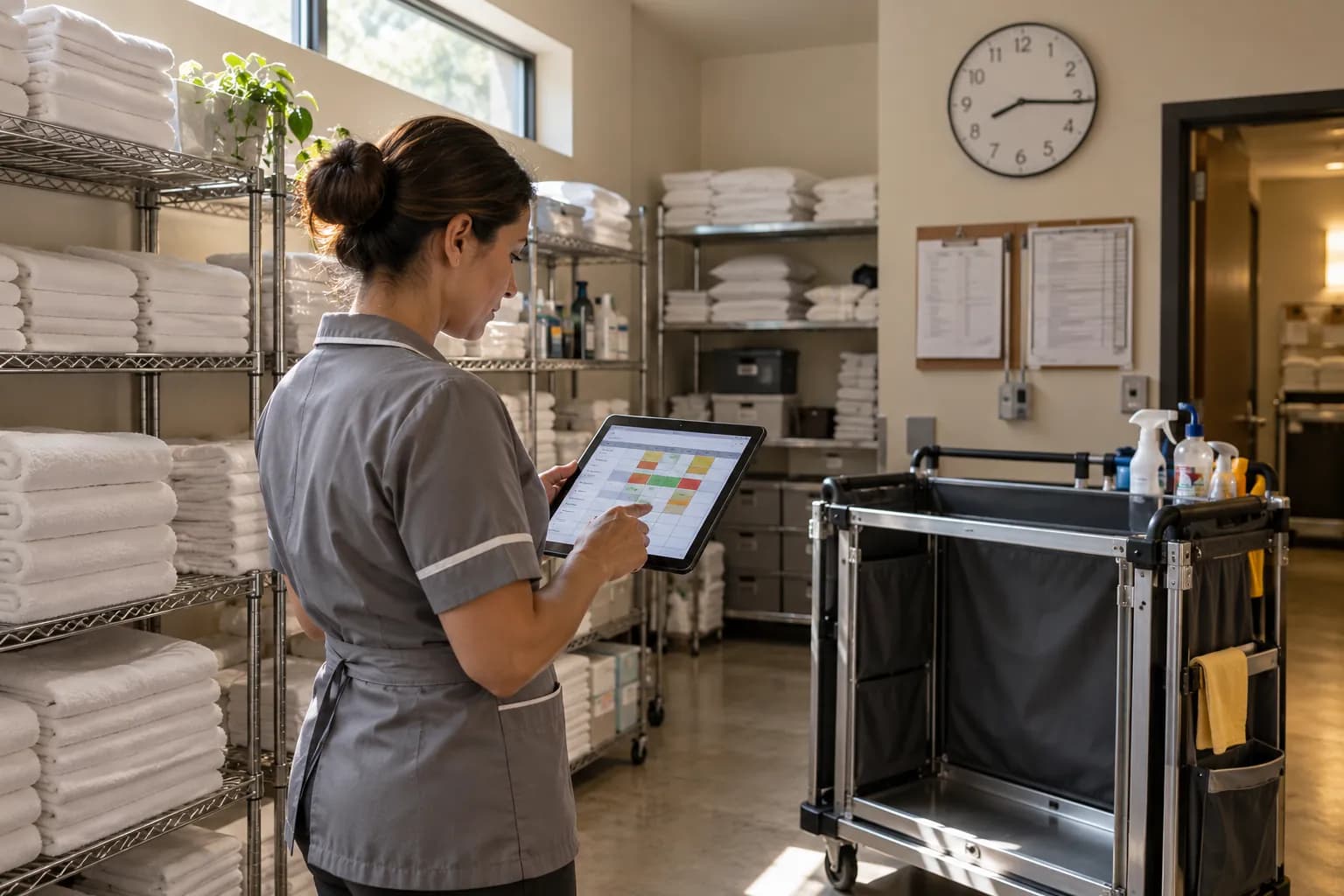
A housekeeping supervisor in the linen room at 08:15 looking at a tablet board beside an unloaded cart
Guided story · illustrative operation

What happens next

Sixty-two dirty rooms, three attendants

It is Saturday, 08:42. There are 41 arrivals today, twelve guests have asked to check in before 15:00, and at 08:15 one attendant did not clock in; her cart is still in the linen room. The board in front of you is fed straight from the property system: 62 rooms dirty, three attendants on the floor, every due-in room flagged by its arrival hour. Nobody walked the corridors to learn this. It used to be the desk that found out, at 13:00, from a guest holding a suitcase.

The underlying problem

Housekeeping is already short because permits end on fixed dates, so there is no slack when one attendant does not clock in at 08:15. Fourteen rooms have nobody assigned, and twelve guests have asked to check in early. Today the desk finds out at check-in, from a guest with a suitcase, and the owner ends up stripping beds.

Early arrivals are not turned away and every inspection carries a name and a time. The shortage is not solved; you just stop discovering it at the desk.

Try this exact scenario in the real demo ↗

Fictional operation and simulated incidents. Human decisions and technical integrations depend on each client's actual systems.

The guest is usually the one who finds it.

A cold room.
A missed test.
A guest nobody answered.

Someone walks the same corridors to check the same rooms. The hot tub reads low on chlorine, and nobody knows the drum ran dry an hour ago. A guest with a suitcase asks if the room is ready, and the whiteboard still shows this morning.

Connect the reading to the right place, person and next step: an alert to the supervisor on the floor, a work order to the one person in maintenance, a text to the guest who is early. Then the day stops being a series of discoveries, and the owner sees the property as it is, not as last month's statement described it.

The front desk
The rooms
The pool deck
The boiler room
The residences
One connected view

Every part of the operation

The front desk of a lakeside inn, one agent checking in a couple while a tablet shows the arrivals list
Front desk

Front desk & bookings

Arrivals, the booking line, the OTA inbox and an AI agent that still answers at 2 a.m.

At an 84-room inn one agent answers the phone, the OTA inbox and the walk-in; after 23:00 the reservations line goes to voicemail while the night auditor covers the desk alone. Booking.com and Expedia score how fast you reply, and the usual guidance is a text inside five minutes and an email inside two hours. About half of Canadian bookings come through those OTAs at 15 to 30 per cent commission, and across Cloudbeds properties they cancel about twice as often as direct ones, so roughly one OTA room-night in five is sold twice. Then a dead access point in the east wing gets written up as the room: in a 2025 US guest survey, fast, free Wi-Fi ranked first.

The dashboard reads arrivals and room status from the property system, so the desk sees which due-in rooms are ready, by the hour. An AI guest agent answers breakfast, parking, late-checkout and directions questions on SMS, WhatsApp, webchat and the OTA inbox in English and French, says it is an AI, and hands the rest to a person with the booking on screen. When an OTA booking cancels inside fourteen days, the room goes back on sale everywhere as usual, and past guests who opted in get an offer for those dates with a value add, never a rate that breaks parity. The owner sees direct against OTA, net of commission, this week.

On the dashboard
  • Rooms ready vs due-in by hour
  • OTA message response time
  • Agent handled vs handed off
  • Direct vs OTA share, net of commission
  • Abandoned and after-hours calls
  • Wi-Fi uptime and clients per access point
Equipment it connects
  • Cloud PMS and booking engine
  • Channel manager and OTA extranets
  • AI guest agent and shared inbox
  • Cloud PBX with after-hours routing
  • P2PE payment terminals
  • Guest Wi-Fi gateway with dual WAN

Open this area in the demo
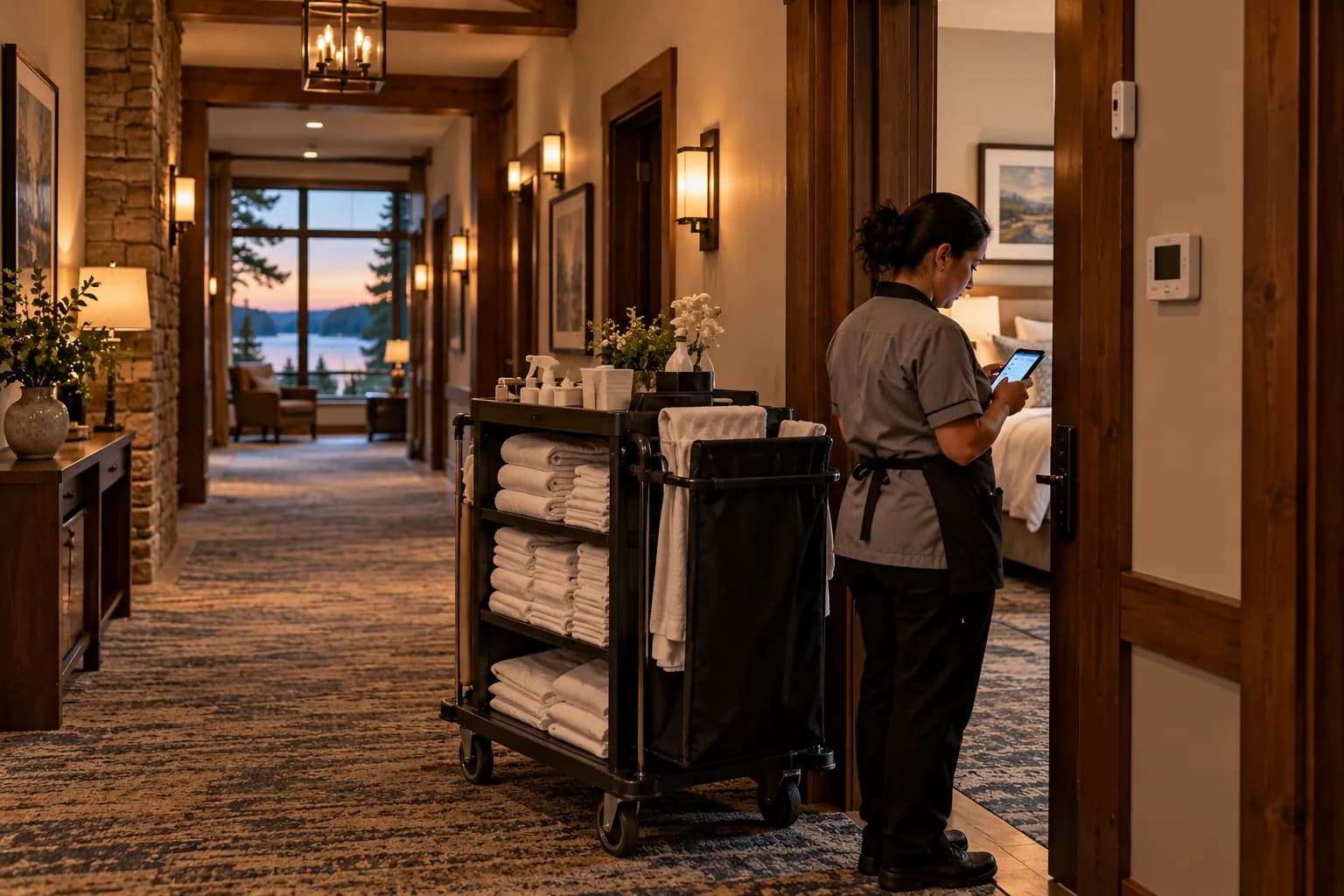
A hotel corridor with a housekeeping cart beside an open guest-room door and an attendant checking a phone app
Rooms

Rooms & housekeeping

Clean, dirty, inspected and out of order in real time, with a name on every inspection.

An attendant turns 12 to 16 rooms a shift. When one does not clock in, a dozen rooms land on someone else, the supervisor stops inspecting, and the clipboard cannot say which due-in rooms are dirty at 14:00. There is no slack to absorb it, and the reason is policy. In Hotels Canada's 2026 survey, 84 per cent of hotels rely on international workers for housekeeping and 46 per cent lost some to expiring permits in a year. The low-wage TFW stream is capped at 10 per cent of a workforce, and Ontario is not taking part in the 2026–27 rural relief. Overtime at 44 hours and eight hours between shifts decide who you can call in.

The housekeeping board is fed by the property system: rooms clean, dirty, inspected or out of order, due-ins flagged by arrival hour, sections in arrival order. An unfilled shift is offered by text to the people trained on the floor, under 44 hours this week and eight hours past their last shift. Where the locks are online, battery levels and failed entries join the board; where they are not, it runs on the attendant's phone and the thermostat. A room that reads 11 °C or a wet sensor under a tub raises a maintenance ticket before a guest sees it, and every inspection carries a name and a time.

On the dashboard
  • Rooms clean, dirty, inspected, out of order
  • Rooms per attendant and minutes per room
  • Hours this week against the 44-hour line
  • Inspection pass rate and re-cleans
  • Room temperature and humidity, occupied vs vacant
  • Lock battery and failed-entry events
Equipment it connects
  • Housekeeping board and mobile app
  • In-room PTAC or VRF with occupancy control
  • Guest-room locks (RFID or mobile key)
  • Leak and humidity sensors under sinks and tubs
  • Laundry washers and dryers with chemical dosing
  • Maintenance tickets with photo into the CMMS
Open this area in the demo
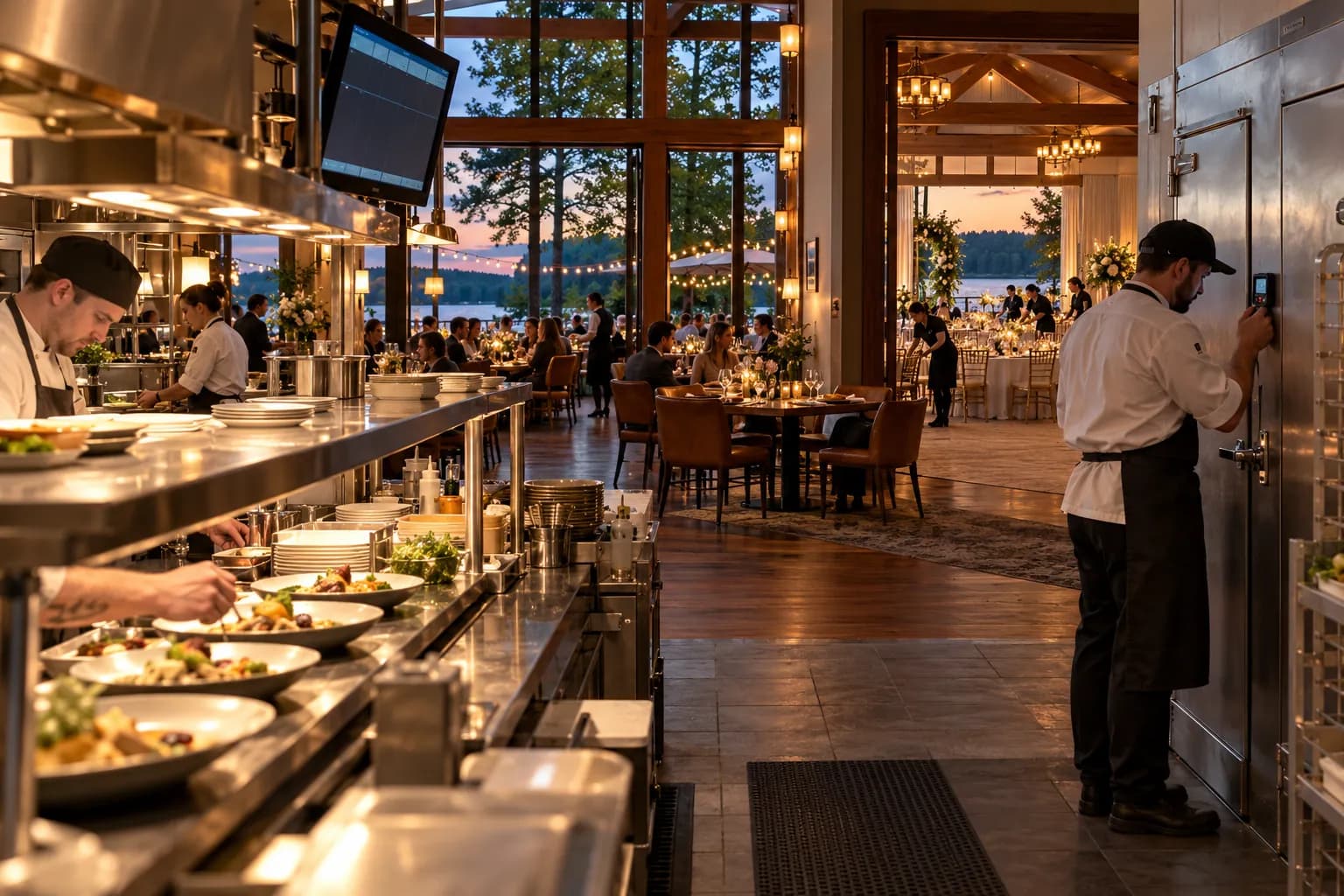
A lakeside hotel restaurant at the start of dinner service, with the kitchen pass and a walk-in cooler probe display
Dining

Restaurant, bar & events

Covers, coolers and the BEO the kitchen is actually cooking from.

The guarantee was 80 on Tuesday. The client calls Friday with 92, the kitchen is still cooking from Tuesday's printed BEO, and nobody knows it is twelve plates short until 18:00. The walk-in log is a clipboard: O. Reg. 493/17 wants 4 °C or colder, the inspector checks with their own probe, and when the probe and the clipboard disagree there is nothing else to show. All of it lands on a thin margin. In November 2025, 44 per cent of Canadian restaurants were running at a loss or breaking even, against 12 per cent in 2019, and a hotel restaurant carries banquets on top.

The point of sale posts room charges to the folio and puts covers, average cheque, labour and food cost per outlet in the same picture as the rooms, by the hour instead of three weeks later. Cooler and freezer probes timestamp every reading against the 4 °C line, and the −18 °C working line for frozen food, and an excursion alarms before product is lost, which is also the record the inspector asks for. A changed headcount updates the BEO version the kitchen sees; the captain confirms the plate count and catering bills the higher of the guarantee or the actual. Smart Serve and food-handler certificates, hood cleaning and the liquor licence sit on the same calendar as the fire-alarm inspection.

On the dashboard
  • Covers, average cheque and voids by hour
  • Food cost and labour as a share of F&B revenue
  • Cooler and freezer temperatures with excursions
  • BEO version and guaranteed vs actual headcount
  • POS-to-folio posting failures and open tabs
  • Inventory variance, theoretical vs actual
Equipment it connects
  • POS and kitchen display
  • Walk-in and freezer temperature probes
  • BEO and event management software
  • Reservations and table management
  • Inventory, recipe costing and liquor control
  • Room-charge interface to the PMS
Open this area in the demo
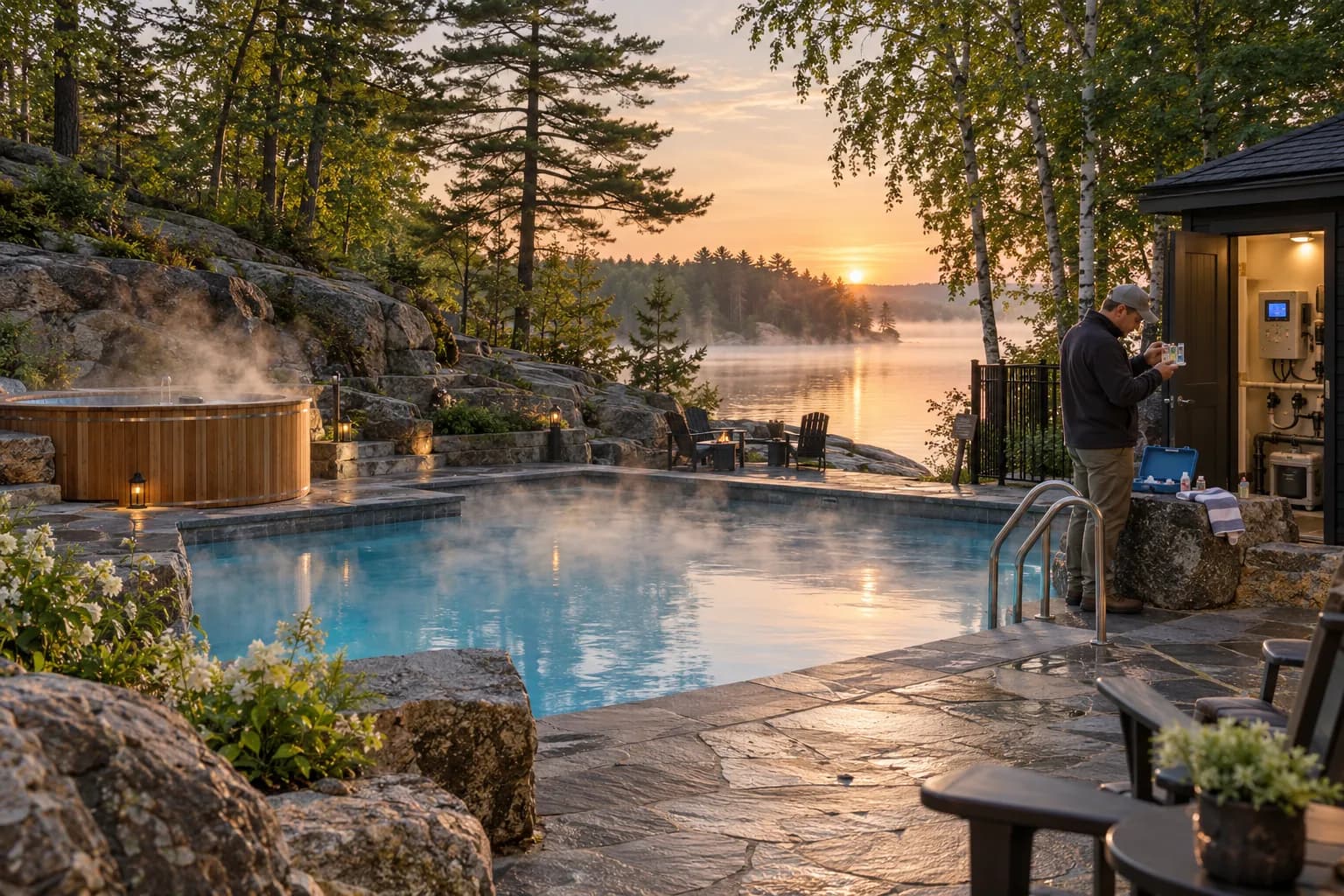
A heated outdoor pool and cedar hot tub on a Muskoka lakeshore at dawn, with the pool operator reading a test kit
Waterfront

Pool, spa & grounds

A controller that watches between tests, a log that gets signed, and a winter record that holds.

On a long weekend nobody is posted on the deck, the desk covers the pool between rounds, and the 11:00 test slips to 12:40. Ontario's Reg. 565 wants a hotel pool tested 30 minutes before opening and every two hours after, or every four with an automatic sensing device, on a daily record someone signs and keeps for a year. A gap shows as a non-compliance on the health unit's published inspection, and a bad enough inspection closes the hot tub. A lodge on a well keeps a second log under O. Reg. 319/08. And a guest who falls on ice has 60 days to give notice, while the lot's history lives in a text thread.

The ORP, pH and chlorine controller trends continuously and alarms on an excursion. The dashboard prompts the manual test, records who took it, keeps the kit reading, the controller reading, the name and the time together, and prints the daily record for the operator to sign. The well chlorinator and residual analyser log against the health unit's directive. Walk-rounds, salt runs and, in season, the snow contractor's check-ins and plow GPS land in a dated winter log per zone: inspected, plowed, salted, by whom. After a storm, a drone survey of the roof and the shoreline goes into the same file. The operator still tests, doses and signs; the chemistry still needs a person.

On the dashboard
  • Free chlorine, pH and ORP, trended
  • Manual test due in (minutes)
  • Daily record signed, by name
  • Pool temperature, pump flow and filter pressure
  • Well chlorine residual and sample due
  • Winter events per zone: inspected, plowed, salted
Equipment it connects
  • Automatic chemistry controller (ORP, pH, chlorine)
  • DPD test kit for the manual test
  • Pool pump, filter, heater and VFD
  • Well chlorinator and residual analyser
  • Irrigation controller and landscape lighting
  • Snow contractor check-ins and plow GPS
Open this area in the demo
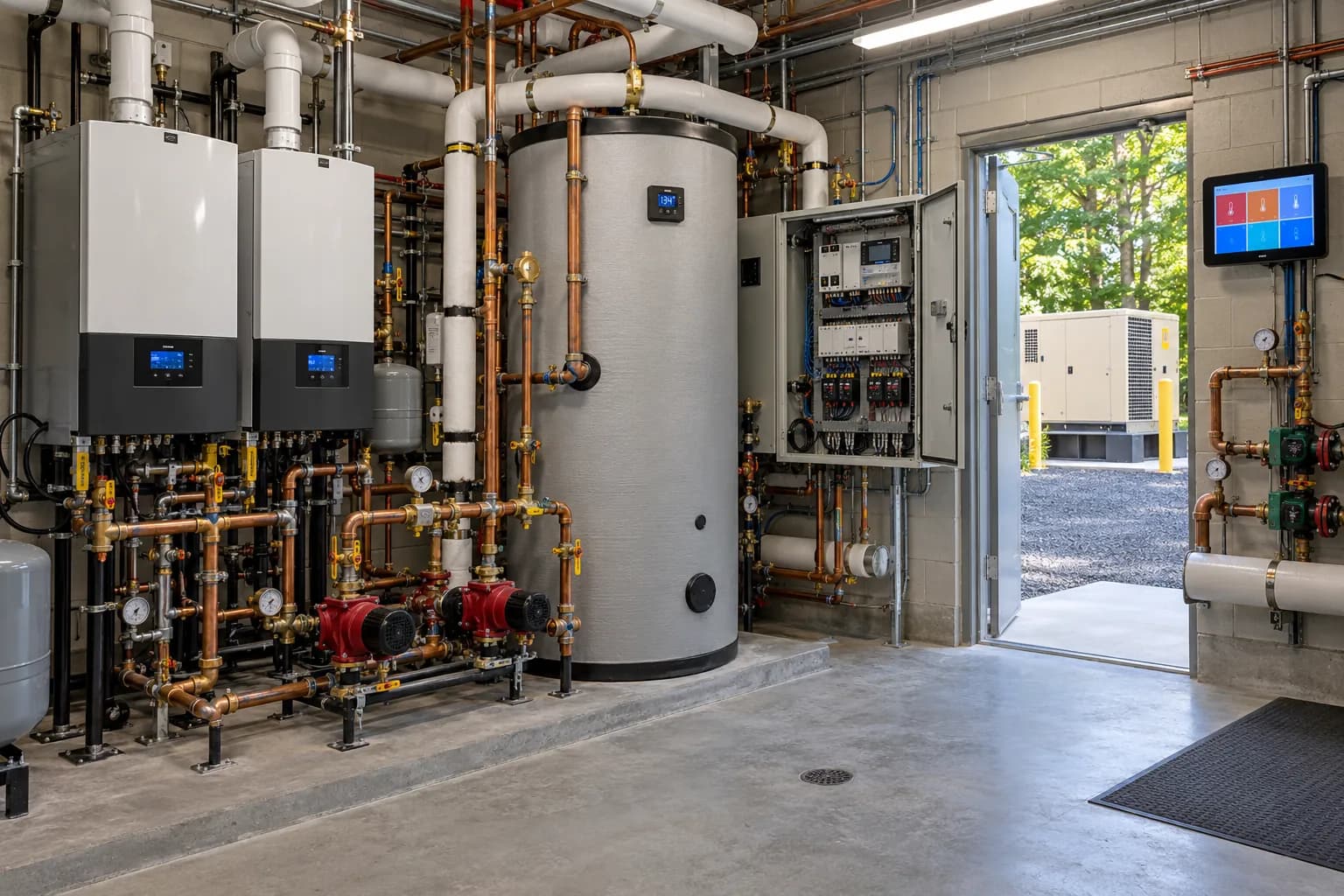
A hotel mechanical room with boilers, a hot-water tank readout, a controller cabinet and a wall tablet showing the building dashboard
Building

Building systems

Hot water, PTACs, the boiler, the elevator, the generator and the inspection calendar on one screen.

A PTAC fleet from 2010 on its second compressors, one boiler and no automation means nothing to read until a cold weekend. HVAC and plumbing cause most emergency callouts in a large US benchmark, and water is the loss that keeps coming: a burst line in a vacant room runs from tens of thousands to six figures. Legionella guidance wants the tank above 60 °C and the return above 49 °C, and in the residences hot water is a vital service under the Residential Tenancies Act. You learn the elevator is out from a complaint, and the fire, sprinkler, boiler and backflow dates live in a binder.

Boiler controls, hot-water sensors, PTACs, meters, the elevator's out-of-service contact, the sump, the leak sensors and the generator report to one building view, over BACnet, Modbus or a simple dry contact. A cold vacant room, a cooling tank or a tripped sump raises a work order and a text to the on-call technician. A residences elevator outage that reaches 48 hours is flagged as reportable, with the start, cause and contractor ticket ready for the TSSA report due within 30 days of the car's return. The owner sees kWh per occupied room and, on a General Service account, the monthly peak, so PTAC warm-up, laundry and kitchen start-up can be kept apart. The inspection calendar speaks up only when a date is close.

On the dashboard
  • Hot-water tank, return and fixture temperatures
  • Room temperature and PTAC faults in vacant rooms
  • Monthly peak kVA and kWh per occupied room
  • Elevator in or out of service, hours out, 48-h reportable flag
  • Leak, sump and generator fuel
  • Fire, sprinkler, boiler and backflow due dates
Equipment it connects
  • Building automation on BACnet/Modbus
  • Boiler, hot-water tank and recirculation sensors
  • Elevator controller out-of-service contact
  • Interval meters and submeters
  • Generator, transfer switch, sump and leak sensors
  • CMMS with a critical-spares list
Open this area in the demo
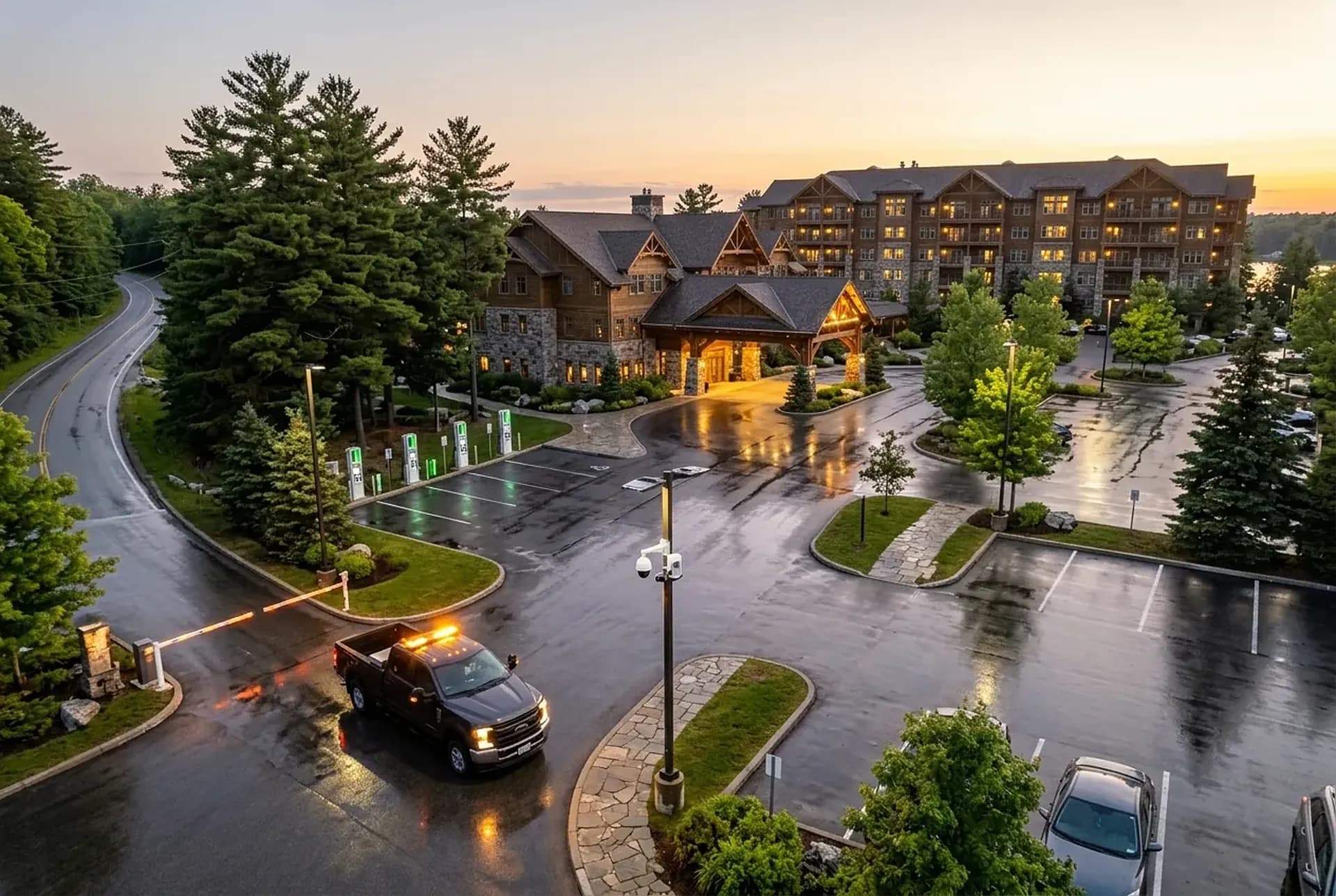
A hotel parking lot at dusk after a summer shower, a grounds pickup at the gate, a camera on a lamp post and the lit inn behind
Security

Access, parking & security

Locks, cameras, the lot and a network built to keep card data out of the way.

At a small property everything tends to sit on one flat network: the guest Wi-Fi, the PMS, the card terminals, the cameras and the office laptop with the shared password. That is one phishing email from a locked front desk on a sold-out night, and the Cyber Centre counts ransomware rising 26 per cent a year from 2021 to 2024. The same flat network drags everything into PCI scope, in full force since March 31, 2025. Ottawa ordered Hikvision Canada to cease operations in June 2025, so those cameras now run on uncertain support. And when a keyless car leaves the lot overnight, the guest blames the hotel.

Guest Wi-Fi, the PMS, the POS and the cameras each get their own segment, with the card terminals on theirs, so the property can stay on the short self-assessment and the guest network stays fast. Cameras and the recorder report offline or obstructed, with retention days known before a 60-day notice arrives. A propped service door, a run of failed key cards or after-hours staff access shows up as an event. The lot's overnight count, lighting outages and the winter log sit beside the camera view, and every staff app, camera and plow tracker carries the electronic-monitoring and privacy policies it needs. It lowers the risk and keeps the paperwork ready. It is never a guarantee.

On the dashboard
  • Failed credentials, forced or propped doors
  • Cameras online and recorder retention days
  • Parking occupancy and overnight vehicles
  • Patch age, MFA coverage, last restore test
  • Guest Wi-Fi uptime and WAN failover
  • Contractor on site and badge expiry
Equipment it connects
  • Electronic guest-room locks
  • Access control and video intercom
  • Cameras and recorder (non-Hikvision, vendor-supported)
  • Parking gate, plate reader and lot lighting
  • Segmented VLANs, firewall, MFA and tested backups
  • Desk panic buttons and lone-worker app
Open this area in the demo
A small hotel office in the morning, two monitors showing revenue, channel and rent-roll tiles beside a commission statement and a lease binder
Owner

The back office

Channel cost, labour, rent and arrears, and every deadline, this morning rather than at month end.

Canadian hotels earned a 19.1 per cent margin in 2024 with wages at 27.4 per cent of expenses, but the owner reads the P&L weeks after the overtime, the commission statement and the utility bill are sunk. Booking.com invoices monthly while Expedia pays net by virtual card, so the channels never look alike on the bank statement. For the residences, the LTB took 87,993 applications in 2024–25 and an L1 hearing runs three to five months; since September 21, 2026 the N4 period is seven days, old forms are refused from November 30, 2026, and a missed step restarts the clock. Rent roll, arrears and logs are three spreadsheets and a binder.

Revenue from the PMS and POS, the commission statements, payroll and the rent roll come into one owner page you can read at 07:00: RevPAR against the comp set, labour hours per occupied room, commission net by channel, arrears by age, and every date from the fire-alarm inspection to the PCI self-assessment. An N4 goes out on the current form with the termination date computed, and when the seven days end unpaid, the L1 package is ready with the ledger attached. It does not shorten the LTB queue. It means the file is complete the day you need it.

On the dashboard
  • RevPAR and index against the comp set
  • Commission net per channel per month
  • Labour hours per occupied room by department
  • Arrears aging and days since the N4
  • MAT and HST remittances due by municipality
  • Open claims and the broker's renewal questions
Equipment it connects
  • Accounting linked to PMS, POS and rent roll
  • Payroll and scheduling with ESA rules
  • OTA commission statements and virtual-card settlement
  • Lease and tenancy management with N4/L1 workflow
  • MAT, HST and licence calendar
  • Insurance, claims and the owner reporting pack
Open this area in the demo
Guided scenarios

Pick a real problem.
Watch it get solved.

Each scenario opens the live demo and walks you through it click by click: the exact control to press, what the dashboard is doing behind it, and what that means for your day. Press Start on any card to begin.

  1. Scenario 01 · Today
    4 min

    The 8:15 gap

    Housekeeping is already short because permits end on fixed dates, so there is no slack when one attendant does not clock in at 08:15. Fourteen rooms have nobody assigned, and twelve guests have asked to check in early. Today the desk finds out at check-in, from a guest with a suitcase, and the owner ends up stripping beds.

    Early arrivals are not turned away and every inspection carries a name and a time. The shortage is not solved; you just stop discovering it at the desk.

    • Rooms & housekeeping
    • Front desk & bookings
    • Building systems
    Start this scenario
  2. Scenario 02 · Today
    3 min

    The hot tub and the empty drum

    The hot tub opens at nine on a wedding Saturday, and the chlorine drum ran dry an hour ago. The pre-opening test will find the low reading but not the reason, and the spa stays shut while someone works it out. Meanwhile Reg. 565 wants a signed test before opening and every two to four hours after, and a skipped one shows on the health unit's published inspection.

    The controller watches between tests and the record is complete; the operator still tests, doses and signs. Someone still has to carry the chlorine.

    • Pool, spa & grounds
    • Building systems
    Start this scenario
  3. Scenario 03 · Today
    4 min

    The vacant room on the first hard frost

    Nobody opens a vacant room on a weekend. On the first hard frost of the fall the PTAC in 214 stops heating at 03:30, and the room starts falling toward the point where pipes burst. The hot-water return slips under the Legionella line. Then freezing rain brings the lines down, as ice did across Muskoka in March 2025, and the generator and the sump sit unwatched between walk-throughs.

    The burst pipe does not happen, the hot-water complaint never starts, and the outage is run on fuel hours instead of guesses. The morning warm-up stops setting the month's peak: a smaller line on the bill, not a transformation.

    • Building systems
    • Rooms & housekeeping
    • Access, parking & security
    Start this scenario
  4. Scenario 04 · 2027
    4 min

    Where did $39 a room-night go?

    Revenue is up and the bank balance is not. About half of Canadian bookings come through OTAs at 15 to 30 per cent commission, and they cancel about twice as often as direct ones. Booking.com invoices monthly, Expedia pays net by virtual card, and the owner reads the P&L three weeks after the money left. The residences' rent roll is a third spreadsheet.

    The leak is visible and a few points of share move toward direct over a season. OTAs stay the biggest channel; the win is knowing the number this morning and acting weekly.

    • Front desk & bookings
    • The back office
    • Restaurant, bar & events
    Start this scenario
Live demo

Step inside
Lakeshore Inn & Residences

Walk every area, watch the alerts arrive, open the details behind them and run the guided scenarios yourself. It is a fictional operation built for the demo: nothing to install, no account, nothing of yours is collected.

Muskoka, Ontario · 84 rooms · 36 residences

Try the live demo4 guided scenarios · 7 areas
Lakeshore Inn & Residences · Overview · 08:42
Today and 2027

What the next two seasons
ask of the house.

Each pressure below comes from the research behind this page, with its date and its source. None of it is a prediction about software. These are rules, prices and weather that reach an inn whether or not anything is connected.

Today

01
Housekeeping runs on permits with end dates
Hotels Canada's 2026 survey found 84 per cent of hotels rely on international workers for housekeeping, and 52 per cent expect to lose some to expiring permits in the coming year. The 10 per cent cap on low-wage TFW hiring, in place since September 26, 2024, stays; Ontario is not taking part in the 2026–27 rural relief; and minimum wage has been $17.95 since October 1, 2026. Every attendant lost is a dozen rooms someone else absorbs.
02
Reg. 565, the hot-water loop and the well
A hotel pool is tested before opening and every two hours, or every four with a sensing device, on a record signed and kept a year. Legionella guidance keeps the hot-water tank above 60 °C and the return above 49 °C. A lodge on a well logs residual and samples under O. Reg. 319/08. All three are readings a controller can watch between the tests a person still takes.
03
The N4 is seven days, and old forms are refused
Since September 21, 2026 the N4 termination period is seven days, a tenant raises other issues at an arrears hearing only after paying the landlord half the arrears seven days before it, and previous form versions are refused from November 30, 2026. L1 hearings take three to five months. In Toronto, from June 15, 2026 the RentSafeTO colour sign goes on the front door; the service-request, cleaning and pest logs that defend an LTB file are what the evaluator asks for.
04
Water and weather are the losses that keep coming
2024 was Canada's costliest severe-weather year at $8.5 billion insured; 2025 added $2.4 billion, including the March 29–30 ice storm that cost $466 million and left Muskoka and Simcoe without power for days. Brokers now ask about water sensors, sprinkler and backflow records and roof age at renewal, and the answer moves the premium and the deductible. Sump pumps and tank rooms sit unwatched between walk-throughs.

2027

01
Ransomware keeps climbing, and the network decides the paperwork
The Cyber Centre counts a 26 per cent average yearly rise in ransomware from 2021 to 2024 and expects Canadian targets through 2027. Since March 31, 2025 every PCI DSS v4.0.1 requirement is mandatory, and a small property self-attests. Segmentation keeps the guest Wi-Fi fast and the rest of the network out of the card terminals' scope, and Hikvision's June 2025 order means any of its cameras need a plan.
02
Bookings arrive from assistants, and the first price must be the whole price
Seventy per cent of hotel chains expect AI booking channels to move direct volume, and only 22 per cent monitor how they appear there. The Competition Act's drip-pricing rule means any mandatory fee belongs in the first price on your engine. An AI guest agent should say it is an AI, needs CASL consent before it sends an offer, and answers French-first in Quebec. The listing content assistants read is now a front-desk job.
03
Energy reporting widens and the bill is about the peak
Toronto's mandatory energy and water reporting reaches buildings of 929 to 4,644 m² (10,000 to 49,999 sq ft) in the 2027 cycle, deadline July 2, 2027, which captures most of the city's mid-size hotels and apartment buildings. A property above 50 kW pays the hourly market price plus Global Adjustment and a distribution charge on its monthly peak, so laundry, kitchen start-up and hot-water recovery should stop landing in the same fifteen minutes.
04
Hurricane season, salt air and the owner in Ontario
Hurricane Melissa on October 28, 2025 closed at least 26 Jamaican resorts; Starlink came back first, then congested. A Caribbean property pays about US$0.35 per kWh, which is why resorts are building solar, batteries and generators, and salt air shortens the life of unprotected outdoor HVAC. The owner in Ontario needs fuel hours, cistern days, chlorine at the tap and link status during the storm, not in the claim afterwards.
A practical partner. A useful first step.

Let your expertise
reach every room.

You know the property and the guests. We connect the equipment, the readings and the people around them, and we say so if we are not the right fit.

  1. 01
    Walk the property
    A morning on site: the desk at 08:15, the pool deck, the boiler room, the lot and the residences, to see where the day gets interrupted and which systems already hold the answer.
  2. 02
    Prove one connection
    A pilot with your people and your existing equipment: the hot tub controller to a signed record, a cold room to a work order, or the OTA invoice to the owner page. One handoff, measured.
  3. 03
    Build on the result
    Expand what earned its place. The second connection reuses most of the first, and nothing is added because a brochure said so.
Start with a real problem on the property.

What should be
easier tomorrow?

A hot tub log someone missed on a long weekend. A cold room nobody knew about until the guest did. A Booking.com invoice that never matches the bank.

Pick everything that applies

Takes you to the contact form with these notes filled in. A real person replies within one business day.